
Benchmark BSE Sensex rebounded by 344 points while Nifty closed above the 16,000 level in choppy trade on Friday, snapping the four-day falling streak on renewed buying interest from foreign funds and firm global trends. The 30-share BSE barometer climbed 344.63 points or 0.65 per cent to settle at 53,760.78. During the day, it jumped 395.22 points or 0.73 per cent to 53,811.37.

Infy, L&T key movers while auto stocks dropped

The rupee on Wednesday dropped by 73 paise to 61.20 in the late morning deals on persistent month-end dollar demand from importers on the back of strengthening in the US currency overseas.

Realty, pharma and FMCG shares buck trend.

In line with Sensex, the broader indices also saw hefty losses. Large cap index tumbled 0.79 per cent, midcap 0.87 per cent and smallcap 0.57 per cent.

Equity benchmarks shrugged off lacklustre global cues to clock smart gains on Tuesday, buoyed by strong buying interest in index heavyweights Reliance Industries and HDFC twins. However, a depreciating rupee and unabated foreign fund outflows capped the gains, traders said. The 30-share BSE Sensex rallied 562.75 points or 0.94 per cent to settle at 60,655.72.

'India has the potential to do a lot more to take advantage of the time today where we stand to gain, geopolitically and in terms of market attractiveness.'

These stocks offer the best combination of maximum 'buy' recommendations from brokerages and share price upside over the next 12 months.

The NSE 50-share Nifty also closed higher by 61.60 points, or 0.59 per cent, at 10,504.80 after shuttling between 10,513 and 10,441.45.

The Nifty ended with a gain of 58 points at 4,571. The index today surged to a high of 4,582 - up 107 points from the low of 4,475.
Foreign fund inflows and a higher opening in the domestic equity market supported the domestic unit

The Nifty, after dropping below the 6K mark on Tuesday, once again gained strength. The index, after flip-flopping between the zones ended finally at 5,999 - up 10 points. BSE market breadth was weak. Out of 3,085 stocks traded, 1,872 declined while 1,065 advanced.

Invesors are caught between bullish China and bearish India.

Markets end four-day losing streak led by shares of private banks, rebound in L&T and Tata Steel.

The headline for corporate profit growth has been very encouraging in the July-September quarter (Q2) of 2023-24 (FY24), with the combined net profit of listed companies up by 38 per cent year-on-year. However, the earnings distribution has been very lopsided, with most of the growth coming from public-sector oil-marketing companies (OMCs), banks, non-bank lenders, automobile (auto) companies, and cement producers. By comparison, companies from information technology services, fast-moving consumer goods (FMCG), retail, and consumer durables were disappointed, experiencing a sharp slowdown in net sales growth and a relatively muted increase in reported net profit.

The Nifty spurted to a high of 5416, and finally ended with a marginal gain of 11 points at 5409.

'The good news is that till the time there is growth in gross domestic product, Indian markets will continue to rise.'

A downturn in Indian demand could hit global gold prices.

The broader NSE Nifty after shuttling between 10,451.90 and 10,595.75 finally ended 100.30 points, or 0.96 per cent, higher at 10,582.50.

Fresh month-end dollar demand from importers, mainly oil companies, affected the rupee's value against the dollar, a forex dealer said.

The rupee on Wednesday declined by 16 paise to close at its fresh lifetime low of 77.60 against the US dollar amid unabated foreign fund outflows and a stronger greenback in overseas markets. At the interbank foreign exchange market, the rupee opened lower at 77.57 and later hit the day's low of 77.61 as the dollar rebounded in global markets following hawkish comments from US Federal Reserve chief Jerome Powell. Crude oil prices also surged over 1 per cent, which weighed on the rupee.

Metal stocks lose ground with Hindalco, Tata Steel, Sesa Sterlite down 4-10%.

Bajaj Finance was the top gainer in the Sensex pack, rising around 5 per cent, followed by IndusInd Bank, Tata Steel, ITC, Bajaj Finserv, Tech Mahindra and Infosys. On the other hand, Maruti, Bajaj Auto, Nestle India, PowerGrid and Axis Bank were among the laggards.

Nifty ended down marginally at 5,625 -- down seven points.

The FMCG sector is generally considered to be a safe haven during difficult times as people never stop buying soap and toothpaste. However, weak rural and semi-urban demand has been a factor since the lockdowns of 2020-21 while rising inflation has also impacted margins. While the FMCG majors have survived on the basis of price hikes and good management practices, they have seen growth slowdowns and experienced margins being squeezed as raw materials and transport costs rose. The FMCG sector witnessed positive volume growth in the fourth quarter of the 2022-23 financial year (Q4FY23) after five consecutive quarters of decline, and the rebound in demand was led by urban markets.

HDFC was the top loser in the Sensex pack, shedding over 1 per cent, followed by Nestle India, ICICI Bank, Kotak Bank and HDFC Bank. The NSE Nifty declined 15.35 points to 17,546.65.
.jpg)
Snapping a two-day fall, the rupee opened strong at 59.49 a dollar from the previous close of 59.76 at the Interbank Foreign Exchange Market and then touched a low of 59.59.

Benchmark Sensex declined 224 points on Wednesday, snapping its four-session winning streak, mainly due to sell-off in IT and pharma counters amid rising concerns over possible aggressive interest rate hikes to tame high inflation. The 30-share index rebounded more than 1,200 points from the early lows before settling at 60,346.97 points, a total loss of 224.11 points or 0.37 per cent compared to Tuesday's closing level. The broader NSE Nifty closed lower 66.30 points or 0.37 per cent at 18,003.75 points.

The Nifty ended down 51 points at 4,953 - slipping once again below the 5,000 mark which it had crossed yesterday.
Mirroring weak cues from the overseas markets, the Sensex opened with a negative gap of 215 points at 10,765. The index thereafter tried to recover but slipped to lower levels after the Reserve Bank of India (RBI) announced its annual credit policy.
In overseas trade, the American currency traded lower against the yen and the euro in an Asian session as well as modest profit-taking after recent sharp gains
.jpg)
The local currency opened at 62.20 a dollar from the previous close of 61.93 and immediately touched a low of 62.29 at the interbank foreign exchange market.

Market participants are impressed that Rajan has set the ball rolling on his first day at RBI with a series of announcements, raising expectations that more are in store.

The recent surge in crude oil prices could shave off the gains made by India Inc in profit margins in the past few quarters. Worse, it comes at a time when consumer demand in the country is slipping and major global economies are witnessing a slowdown. A back-of-the-envelope calculation suggests that the margin expansion accounted for three-fourths of the rise in the listed firms' operating profit between the April-June quarter (Q1) of FY23 and Q1FY24, and only a quarter of profits gains came from revenue growth.

While Vedanta was the biggest gainer in the Sensex pack rallying 4.67 per cent, others included Tata Steel, ONGC, NTPC, Yes Bank, Infosys, Sun Pharma, Bharti Airtel, SBI, Bajaj Finance, L&T and RIL, rising up to 4.13 per cent.
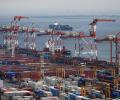
Export trade during August 2018 recorded at $27.84 billion, a positive growth of 19.21 per cent, tweeted Prabhu.

Benchmark BSE Sensex rallied nearly 630 points while Nifty closed above the 16,500 mark on Wednesday after sharp gains in IT and energy shares amid positive global market trends. Buying in index majors Reliance Industries, Infosys and Tata Consultancy Services and FII inflows bolstered the sentiment. Shares of firms related to oil exploration and refineries were in heavy demand, with Reliance Industries rallying 2.47 per cent and ONGC by 4 per cent, as the government slashed windfall tax on petrol, diesel, jet fuel and crude oil.

Moody's on Thursday upped India's growth projection for the next financial year beginning April 1, to 13.7 per cent, from 10.8 per cent estimated earlier, on the back of normalisation of activity and growing confidence in the market with the rollout of COVID-19 vaccine. For current fiscal, the US-based rating agency expects the economy to contract 7 per cent, lower than its previous estimate of 10.6 per cent contraction.

India is expected to contribute 15 per cent to the global growth in 2023, an International Monetary Fund (IMF) official said on Tuesday. "Both India and China are expected to contribute 50 per cent of the global growth in the upcoming year (2023). "However, the share of India's contribution to global growth is expected to be around 15 per cent," Krishna Srinivasan, director, Asia and Pacific Department (APD) at IMF said at a roundtable with reporters from south Asian countries.

Growth in India is expected to slow to 6.3 per cent in FY 2023/24 (April-March), a 0.3 percentage point downward revision from January, the World Bank said Tuesday but noted there is an unexpected resilience in private consumption and investment and robust growth in the services. The World Bank made these points in its latest edition of Global Economic Prospects according to which global growth is projected to decelerate from 3.1 per cent in 2022 to 2.1 per cent in 2023. In Emerging Markets and Developing Economies (EMDEs) other than China, growth is set to slow to 2.9 per cent this year from 4.1 per cent last year. These forecasts reflect broad-based downgrades.
